






Overview
Overweight and obesity: a deeper look at the science of weight

Medically reviewed · Updated July 2026 · VIVUS-supported resource.
The key aspects
The short version
Weight exists on a continuum
From underweight to obesity, there is no single threshold that defines health.
BMI is only one indicator
It measures body size, not health. Context and additional measures matter.
Weight is biologically regulated
Your body actively defends a set point, making sustained weight change challenging.
Many factors influence weight
Genetics, sleep, hormones, stress, medications, and environment all play a role.
Treatment is possible
Evidence-based approaches — lifestyle, psychology, and medicine — can help.



DEFINITIONS
What are overweight and obesity?
Overweight and obesity sit on a single continuum of body weight relative to height: not two separate conditions.
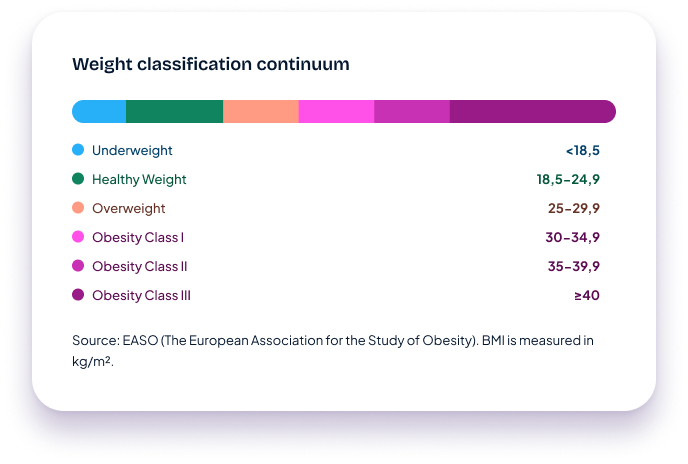
The usual starting measure is BMI: for adults, 18.5–24.9 is the healthy range, 25.0–29.9 is overweight, and 30 or above is obesity, which is split further into Class I, II and III.1,2
Overweight is best understood as a risk state and an early opportunity to act while obesity is the more advanced stage, where health risk and the case for support are greater.
BMI is a useful signal, not a verdict. It can’t tell muscle from fat or show where fat is stored, so a waist measure is used alongside it a simple guide is to keep your waist to less than half your height.2,3
BMI CALCULATOR
What does your BMI mean?
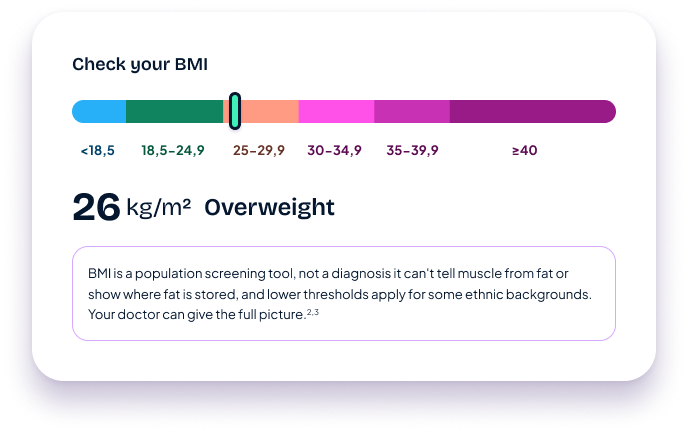
Body Mass Index is a widely used screening tool calculated from height and weight. It provides a quick snapshot of weight status but should always be interpreted alongside other clinical information.
Our calculator places your result on this scale as a starting point for a conversation.
PSIHOLOGY
How does your body control your wheight?
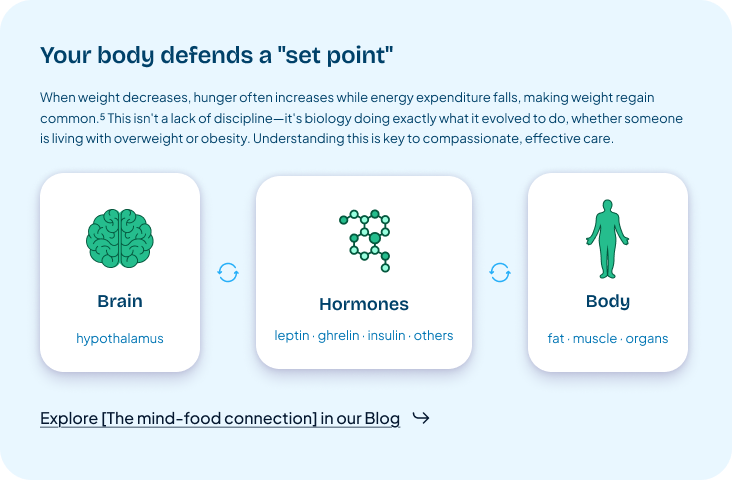
Your weight isn’t determined by willpower alone—it is regulated by a constant conversation between your gut, fat tissue and brain.
Hormones signal hunger and fullness to the hypothalamus, while the brain’s reward system influences how appealing food feels.⁴ Body fat itself behaves like an organ, releasing hormones that affect appetite and metabolism.
CARIES
What causes overweight and obesity?
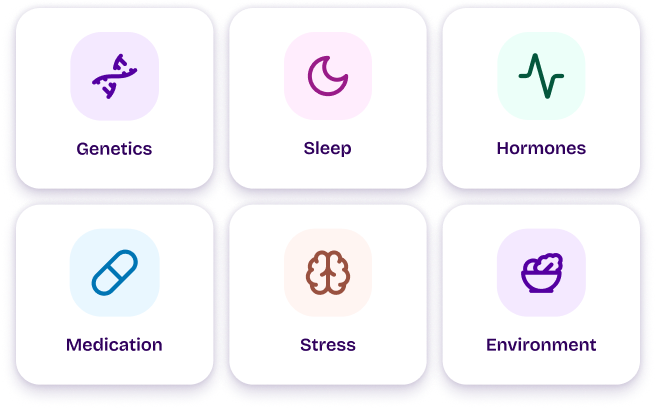
There’s rarely a single cause. Weight is shaped by a mix of factors most only partly within daily control: the genes you inherit, your hormones, how well you sleep, chronic stress, certain medical conditions and medications, and an environment built around cheap, energy-dense food.5,6
For some people one driver dominates — a hormonal condition, a medication’s side effect, or leptin resistance; for most, it’s several factors adding up over years, often gradually moving someone from a healthy weight into the overweight and then obesity range.5
What are the types and stages?
The continuum runs from a healthy weight, through overweight (BMI 25.0–29.9), into obesity, which is divided into Class I, II and III with higher classes carrying higher health risk.2
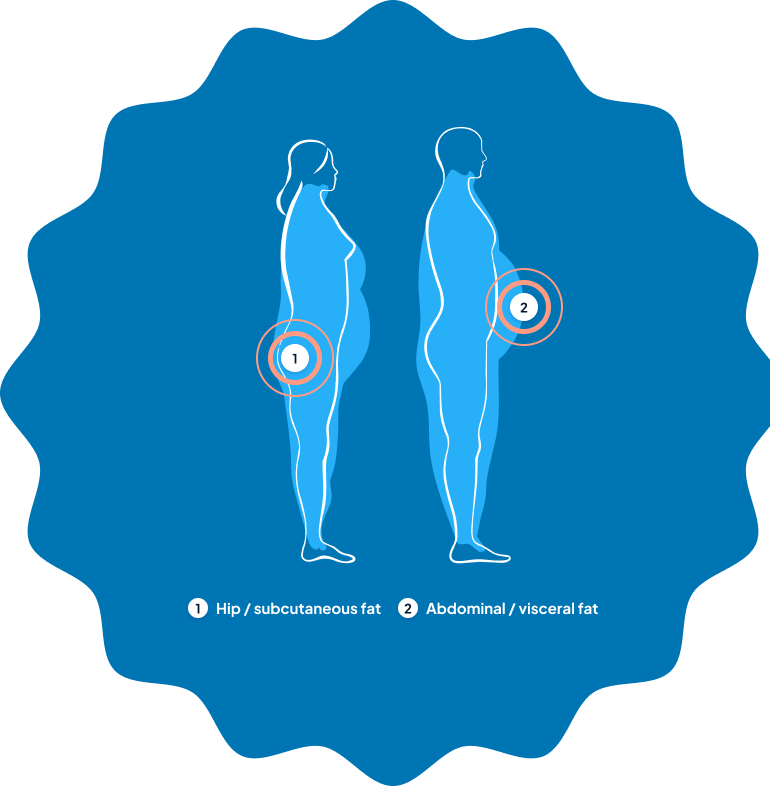
Clinicians also look at where fat is stored: fat around the abdomen (central or abdominal obesity) is more closely tied to heart and metabolic risk than fat on the hips and thighs.7
There are also less-visible forms, such as sarcopenic obesity: the coexistence of excess adiposity and low muscle mass and/or impaired muscle function.⁹. Knowing the stage and the type helps a doctor tailor the right support.
COMMON QUESTIONS
Frequently asked questions
Yes and risk is never fixed. According to the World Health Organisation (WHO), obesity is a chronic complex disease defined by excessive adiposity that impairs health.
Prevention and treatment draw on the same foundations: everyday habits (food, movement, sleep), psychological support, and medical care when it’s needed in the combination that fits your life and health. Acting earlier, at the overweight stage, can be especially effective. Encouragingly, even modest, sustainable changes can improve your health well before the number on the scale moves.7
A doctor can help you find the right path. Start with the Movement hub, Diet & Nutrition, or Psychology.
Yes, to a significant degree. Researchers have linked hundreds of genetic variants to body weight and obesity risk, and twin studies suggest genes explain a large share of the differences between people.8 But inheriting a higher risk isn’t a fixed fate genes interact with environment, sleep and habits rather than acting alone.5
Yes, and it runs both ways: stress, low mood and poor sleep can affect appetite and weight,5. Support for the emotional side is a recognised part of care, covered in the Psychology hub.
References
- World Health Organization. Obesity and overweight (fact sheet). who.int
- National Institute for Health and Care Excellence (NICE). Overweight and obesity management. NICE guideline NG246. 2025. nice.org.uk/guidance/ng246
- Potter AW, Chin GC, Looney DP, Friedl KE. Defining overweight and obesity by percent body fat instead of body mass index. Journal of Clinical Endocrinology & Metabolism. 2025;110(4):e1103–e1107.
- Göbel CH, Tronnier VM, Münte TF. Brain stimulation in obesity. International Journal of Obesity. 2017;41:1721–1727.
- Schwartz MW, Seeley RJ, Zeltser LM, Drewnowski A, Ravussin E, Redman LM, Leibel RL. Obesity Pathogenesis: An Endocrine Society Scientific Statement. Endocrine Reviews. 2017;38(4):267–296.
- World Health Organization Regional Office for Europe. WHO European Regional Obesity Report 2022. Copenhagen: WHO; 2022.
- Elagizi A, Kachur S, Carbone S, Lavie CJ, Blair SN. A review of obesity, physical activity and cardiovascular disease. Current Obesity Reports. 2020;9(4):571–581.
- Loos RJF, Yeo GSH. The genetics of obesity: from discovery to biology. Nature Reviews Genetics. 2022;23(2):120–133.
- Donini LM, Busetto L, Bischoff SC, et al. Definition and diagnostic criteria for sarcopenic obesity: ESPEN and EASO consensus statement. Clinical Nutrition. 2022;41(4):990–1000. doi:10.1016/j.clnu.2021.11.014.